RESPONSIBLE CONDUCT OF RESEARCH

May 2026
REU: Engineering for Healthcare
Jing Pan
Assistant Professor
Mechanical and Aerospace Engineering
Goals for Today
My purpose is to…
- Discuss the importance of ethical conduct of research
- Introduce you to issues you may not have considered
- Provide you with resources
I am not
- An expert on ethics, nor on law
Why does talking about ethics matter?
Evidence shows that discussing ethics results in more ethical behavior.
It also:
- Makes expectations clear to everyone
- Prepares you for unexpected dilemmas
- Is now mandated by funding agencies
However, I am
- Deeply interested in the subject — as everyone should be
- Someone with experience navigating difficult decisions in research
Why Should We Care?
“I would wager that many students do not appreciate the consequences of misconduct when working on a federally funded project. If they fabricate or falsify even a ‘small amount’ of data, they cannot get off with just a slap on the wrist. Suspected misconduct must be reported to the institution’s integrity officer. If found guilty, he or she will likely be debarred from working on federally sponsored research for several years.”
— Marshall Thomsen, APS Newsletter: NSF Ethics Education Requirements
The Legal Mandate
NSF / America COMPETES Act — Federal Register, Vol. 74 No. 160, August 20, 2009
The National Science Foundation requires that each institution applying for financial assistance for science and engineering research describe in its grant proposal a plan to provide appropriate training and oversight in the responsible and ethical conduct of research to undergraduate students, graduate students, and postdoctoral researchers participating in the proposed research project.
💡 Fear of the law is not our primary reason for ethical conduct — but it is real. The deeper reason: our work has far-reaching consequences for human health, global society, and the environment.
Today’s Agenda
| # | Topic |
|---|---|
| 1 | Plagiarism & Citation |
| 2 | Fabrication & Falsification |
| 3 | Data Management |
| 4 | Authorship |
| 5 | Mentor/Mentee Responsibilities |
| 6 | Conflicts of Interest |
| 7 | Human & Animal Subjects |
| 8 | Resources & Broader Concerns |
Topic 1
Plagiarism & Citation
What Is Plagiarism?
Definition (Oxford Languages)
- Transitive verb: To steal and pass off the ideas or words of another as one’s own; to use another’s production without crediting the source
- Intransitive verb: To commit literary theft; to present as new and original an idea or product derived from an existing source
It can be obvious or subtle:
- Wholesale copying of another’s work
- Quoting without quotation marks or citation
- Slightly changing phrasing and claiming it as your own
- Giving an improper or incorrect citation
- Copying an idea without giving credit
- Copying excessive material, even with a citation
Even unintentional plagiarism is a violation.
Detection Is Real — and Growing
Tools publishers use:
- Turnitin — used by many universities
- CrossCheck / iThenticate — major journal publishers run every submission through this
The numbers (Nature, 466, 2010): In one pilot on three journals, CrossCheck caused the publisher to reject 6%, 10%, and 23% of already-accepted papers.
⚠️ New concern: AI citations
AI tools (ChatGPT, etc.) are notorious for generating false or hallucinated citations — real-sounding papers that do not exist.
If you use an AI-generated citation without verifying it, you may unknowingly submit fabricated references.
Always verify every citation at its source.
When Should You Cite?
Always cite when you:
- Quote someone else (rare in technical writing)
- Paraphrase another source
- Use someone’s idea
- Refer to the work of another
- Have relied on the ideas of another source
Citation is not a burden — it gives you advantages:
- Lets readers distinguish your ideas from others’
- Validates the prior work your contributions build on
- Provides sources for readers to pursue
- Demonstrates that you have done your homework
💡 Self-plagiarism: Reusing substantial portions of your own prior published work without disclosure is also a violation. If in doubt, cite yourself.
🎯 Case: Did I Plagiarize?
Situation A: You are writing your REU final report. Your methods section closely follows the protocol paper your lab published two years ago. You paraphrase most sentences but don’t cite the original paper because “it’s just a methods section.”
Situation B: You ask an AI assistant to help you write your literature review. It generates a citation — author, journal, volume, page numbers — that looks completely real. You include it without checking.
Situation C: You are writing a report and find a paragraph in a Wikipedia article that perfectly summarizes the background. You rewrite each sentence in slightly different words but follow the same structure and don’t cite Wikipedia.
🗳️ Discussion: Which of A, B, or C is plagiarism? Which is the most serious? What should you do in each case?
Topic 2
Fabrication & Falsification
Research Fraud — Defined and Growing
Fabrication — making up data or results and recording or reporting them
Falsification — manipulating research materials, equipment, or processes, or changing or omitting data so the record is not accurately represented
Both are federal offenses when they occur on federally funded research.
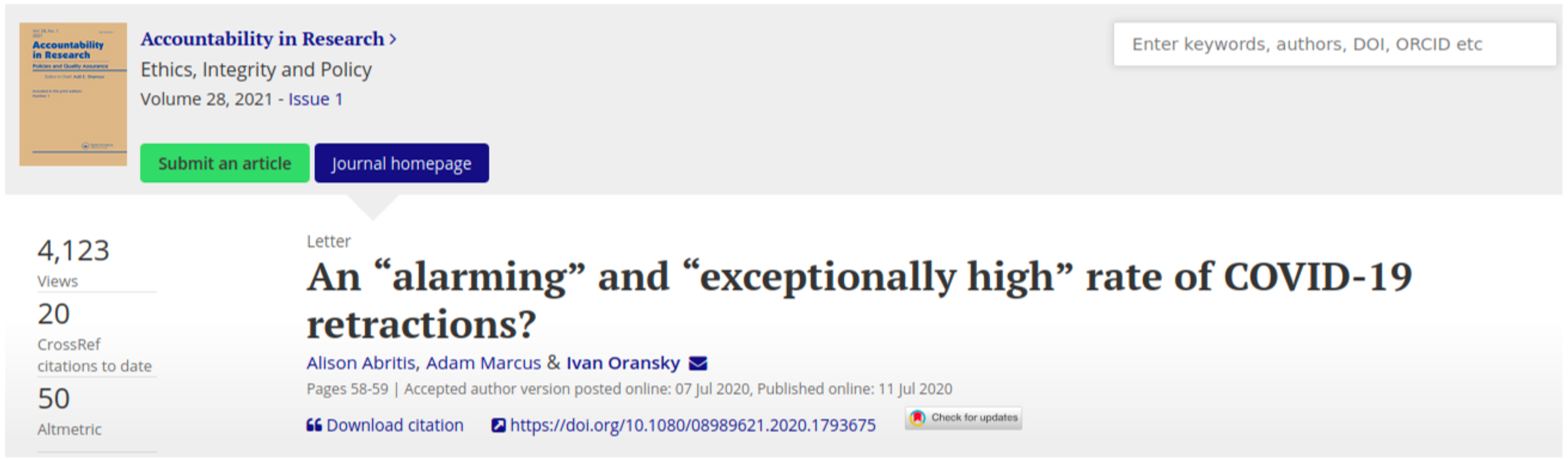
The trend is alarming:
- ~200 papers retracted from PubMed (2000–2010) due to fraud (Journal of Medical Ethics, 37.4, 2011)
- COVID-19 retractions exceeded 300 papers (Retraction Watch, 2022)
- Fraud increasing as competition for grants intensifies (Quality in Higher Education, 26(3), 2020)
Track retractions at retractionwatch.com
The Line Between Judgment and Fraud
Not every questionable decision is misconduct — but the line matters.
| Acceptable | Misconduct |
|---|---|
| Removing an outlier with documented justification | Removing an outlier because it hurts your p-value |
| Image brightness adjustment applied uniformly | Cropping or masking a gel band |
| Rounding to significant figures | Inventing a measurement |
| Choosing one statistical test over another | Running multiple tests and only reporting the favorable one |
💡 The key question: Would a reasonable scientist, knowing your methods, agree this is a legitimate choice? If you’d be embarrassed to explain it, it’s a red flag.
🎯 Case: The Inconvenient Outlier
Situation: You run an experiment five times. Four trials confirm your hypothesis; one is a significant outlier — far outside the range of the others. Your mentor says: “Just drop it — it’s probably instrument error. The trend is clearly there.”
The stakes: This result will appear in a conference paper associated with your NSF REU grant. Fabricating or falsifying data on a federally funded project is reportable to the Office of Research Integrity.
🗳️ Discussion:
- What questions would you ask before deciding whether to remove the outlier?
- What documentation would make removal legitimate?
- How would you respond to your mentor in the moment?
🔬 Recent Case: ThermoFisher Western Blot
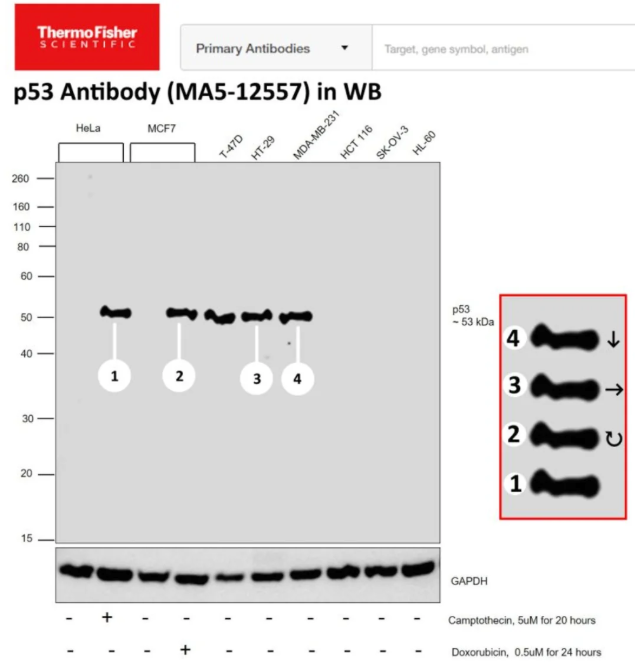
Source: Sholto David, scientific image-integrity investigator. Diagram added to highlight suspiciously identical bands across lanes.
What happened
A scientific image-integrity sleuth flagged the validation western blot for one of ThermoFisher’s antibodies.
Why this matters for you
- Even a multi-billion-dollar reagent company got caught.
- Researchers worldwide may have purchased this antibody based on faked validation data.
Topic 3
Data Management & Reproducibility
Principles of Good Data Management
Record everything
- Date, time, conditions, instrument settings
- Who collected the data
- Deviations from protocol
- Raw data before any processing
Store securely
- Institutional cloud storage
- Version control for analysis code (Git/GitHub)
- Never raw data only on a personal device
Retain your data
NSF requires data retention for at least 3 years after a grant ends. Many journals now require data sharing at publication.
Make it reproducible
A stranger — or your future self — should be able to re-run your entire analysis from your lab notebook and code alone, without asking you a single question.
Data Integrity in Practice
Modeling & statistical integrity:
- Report the assumptions behind your model
- Validate against known cases
- Report errors and uncertainty — not just best-fit values
- Don’t selectively report statistical results
Real-world consequence
In 1999, NASA lost the $327 million Mars Climate Orbiter when one engineering team used pound-force-seconds and another used Newton-seconds in their trajectory software. The spacecraft entered the Martian atmosphere at the wrong altitude and was destroyed.
The error wasn’t fraud — but the damage to careers, the mission, and the program’s credibility was enormous.
Good data practice would have caught it.
🎯 Case: The Vanishing Dataset
Situation: A PhD student graduates and leaves for a position across the country. Their personal laptop has all of the raw experimental data from their dissertation — data that was never uploaded to any lab server. Two years later, a journal reviewer challenges a result in the published paper and requests the raw data. The former student no longer responds to emails.
Questions to work through:
- Who bears responsibility — the student, the PI, or the institution?
- What specific practices would have prevented this situation?
- What happens to the paper if the data cannot be produced?
- How does this affect the REU students who co-authored the paper?
Topic 4
Authorship & Publication Ethics
Who Qualifies as an Author?
APS / ICMJE standard — authorship should be limited to those who have made a significant contribution to the:
- Concept or design of the research
- Execution of experiments or data collection
- Analysis or interpretation of results
Authorship confers both credit and responsibility. An author is accountable for the integrity of the work — not just their slice of it.
What does NOT qualify:
- Providing lab space or funding
- Running a few samples
- Being the department chair
- Editing the manuscript once
- Being a close friend of the PI
These warrant an acknowledgment, not authorship.
Common friction points: Adding, deleting, or changing the order of authors after a draft is complete is one of the most frequent sources of conflict in academic research.
🎯 Case: Jan, Keith, and the Tenure Clock
Situation
Jan and Keith are engineering faculty members seeking tenure. Jan developed a paper during his PhD that he never published. He discusses the idea with Keith, and they agree to revise it together. Jan does most of the revision work; Keith’s contributions are minimal — but Jan agrees to include Keith as co-author to help Keith’s tenure case. The article is accepted and published.
🗳️ Discussion questions:
- Is it ethical for Jan to publish work from his graduate research now? Does his thesis supervisor deserve credit?
- Should the funding source of Jan’s original thesis research be acknowledged?
- Does Keith qualify as an author by the APS standard?
- Who is harmed — and how — if Keith is listed as co-author without sufficient contribution?
🎯 Case: The Summer Poster Session
Situation: Over the summer, you’ve designed and run your experiments, generated the figures, and written most of your final report. Your graduate student mentor helped you set up equipment in the first week and answered questions throughout the summer. They shaped your project, but you did all the hands-on work and most of the analysis. At the end of the summer, your mentor submits an abstract to a conference. The author list reads: [Grad Student], [Your Name], [Another Student], [PI].
🗳️ Discussion:
- Does the grad student mentor qualify as first author? What did they actually contribute?
- Does the other undergrad qualify as an author at all? On what basis?
- What do you say to your mentor, who might write your recommendation letter?
- Does it matter if the conference is small vs. a major venue that appears on everyone’s CV?
Topic 5
Mentor & Mentee Responsibilities
The Power Dynamic in the Lab
Your mentor is responsible for:
- Providing a safe and ethical research environment
- Training you in professional and scientific standards
- Giving honest, constructive feedback
- Never asking you to do something unethical
- Properly crediting your contributions
You are responsible for:
- Asking questions when you’re unsure
- Maintaining accurate, complete records
- Reporting concerns — even uncomfortable ones
- Not cutting corners under pressure
The reality:
Many misconduct cases involve trainees who felt they couldn’t say no to a PI — or were afraid to report a problem.
If you need help:
- Talk to REU program directors.
🎯 Case: The Pressure to Publish
Situation: You are an REU student in your final two weeks. Your PI wants to include your results in a paper being submitted to a high-impact journal — a paper that could significantly help your graduate school applications. While reviewing your figures, your PI says:
“These fluctuations are just instrument noise — can you smooth the data a little before the figure? The trend is clearly there.”
You’re not sure if this is a standard processing step or something else.
🗳️ Discussion:
- What questions would you ask your PI before doing anything?
- How would you find out whether this is standard practice in your field?
- Does the career benefit to you change the ethical calculus?
Topic 6
Conflicts of Interest
What Is a Conflict of Interest?
A conflict of interest exists when personal interests could — or appear to — compromise professional judgment.
💰 Financial
Stock, consulting fees, or a startup that benefits from your research results
🤝 Personal
Reviewing a close friend’s paper, evaluating a competitor’s grant, or hiring a relative
🧠 Intellectual
Strong prior public commitment to a hypothesis that your experiment might disprove
💡 A conflict of interest is not automatically misconduct. Disclosing it and managing it properly — recusing yourself, seeking oversight — is the correct ethical response. Concealing it is what creates the problem.
🎯 Case: The Startup PI
Situation: Your PI holds equity in a startup company that is developing a product based on the research direction of your lab. Your summer project is directly testing the core hypothesis behind that product. The PI has not disclosed this to you. When your results come in — mixed, not as strong as hoped — the PI suggests you frame the conclusions more positively in your final report.
The broader picture: Your REU stipend comes from an NSF grant. The PI’s company could benefit financially from the published version of your work.
🗳️ Discussion:
- What obligations did your PI have to disclose this conflict to you and to NSF?
- How does the financial stake change how you should interpret your PI’s feedback on framing?
Topic 7
Human & Animal Subjects Protection
IRB & IACUC — The Basics
IRB — Institutional Review Board Protects human research participants
- Required for any research involving humans — including surveys, interviews, and observation
- Reviews informed consent procedures
- Applies the Belmont Report principles: Respect for persons, Beneficence, Justice (1979)
- Approval must be obtained before data collection begins
IACUC — Institutional Animal Care and Use Committee Protects animal subjects
- Required for all vertebrate animal research
- Applies the 3Rs: Replace, Reduce, Refine
- Annual protocol review and renewal
⚠️ Bottom line: Never collect data from humans or animals without prior written IRB or IACUC approval. No exceptions — even for a “quick pilot.”
🎯 Case: The Informal Survey
Situation: Your REU project involves understanding how engineers in your department make design decisions under uncertainty. You design a short 10-question survey and send it to 30 graduate students via email. You plan to include the results in your final report and, potentially, a conference paper.
A labmate mentions you should have gotten IRB approval first. You didn’t know surveys required it. You’ve already received 20 responses.
Note: Even anonymous surveys of human subjects may require IRB review, depending on the questions and how results will be used.
🗳️ Discussion:
- Can you use the 20 responses you already have?
- What is the process for getting IRB approval, and how long does it take at UF?
- What are the consequences of publishing data from unapproved human subjects research?
Topic 8
Beyond Today — Broader Concerns & Resources
Other Ethical Issues You Will Face
These topics deserve their own training:
- Intellectual property — Who owns the ideas and inventions from your research? (Hint: often the university)
- Publication vs. confidentiality — Open science vs. sponsor confidentiality agreements
- Peer review integrity — Confidentiality of manuscripts and grant applications you review
- Lab safety & environmental concerns — Proper waste management and disposal
- Classified & restricted research — Special obligations and restrictions
- Collaborative & international research — Different norms, data transfer agreements
- Social media & public statements — Representing your institution and your field
(From the 2023 REU lecture — Prof. Jason E. Butler, Dept. of Chemical Engineering)
Resources
| Resource | Where |
|---|---|
| UF Training | my.ufl.edu → Training |
| ORI — Office of Research Integrity | ori.hhs.gov |
| CITI Program RCR Modules | citiprogram.org |
| NAS: Fostering Integrity in Research | PDF at nap.edu |
Additional resources
- Retraction Watch — retractionwatch.com
- APS Guidelines for Professional Conduct
- Guidelines from your lab
Need help? Talk to:
- Your faculty advisor / mentor — first stop
- Your departmental advisor and chair
You are never alone in navigating these situations.
Key Takeaways
- Talking about ethics makes us more ethical — that’s why we’re here
- Plagiarism is broader than copy-paste — includes improper paraphrasing, AI citations, self-plagiarism
- Fabrication and falsification have federal consequences — even “small” data manipulation
- Data belongs to the lab, not the person — record, store, and retain properly
- Authorship = contribution + responsibility — not seniority or politics
- You have the right to say no — and the right to report concerns safely
- Disclose conflicts of interest — concealment is the problem, not the conflict itself
- IRB/IACUC approval must come first — always, no exceptions
University of Florida · Herbert Wertheim College of Engineering · REU Program